
Hangul Syllable Tracing 가~하
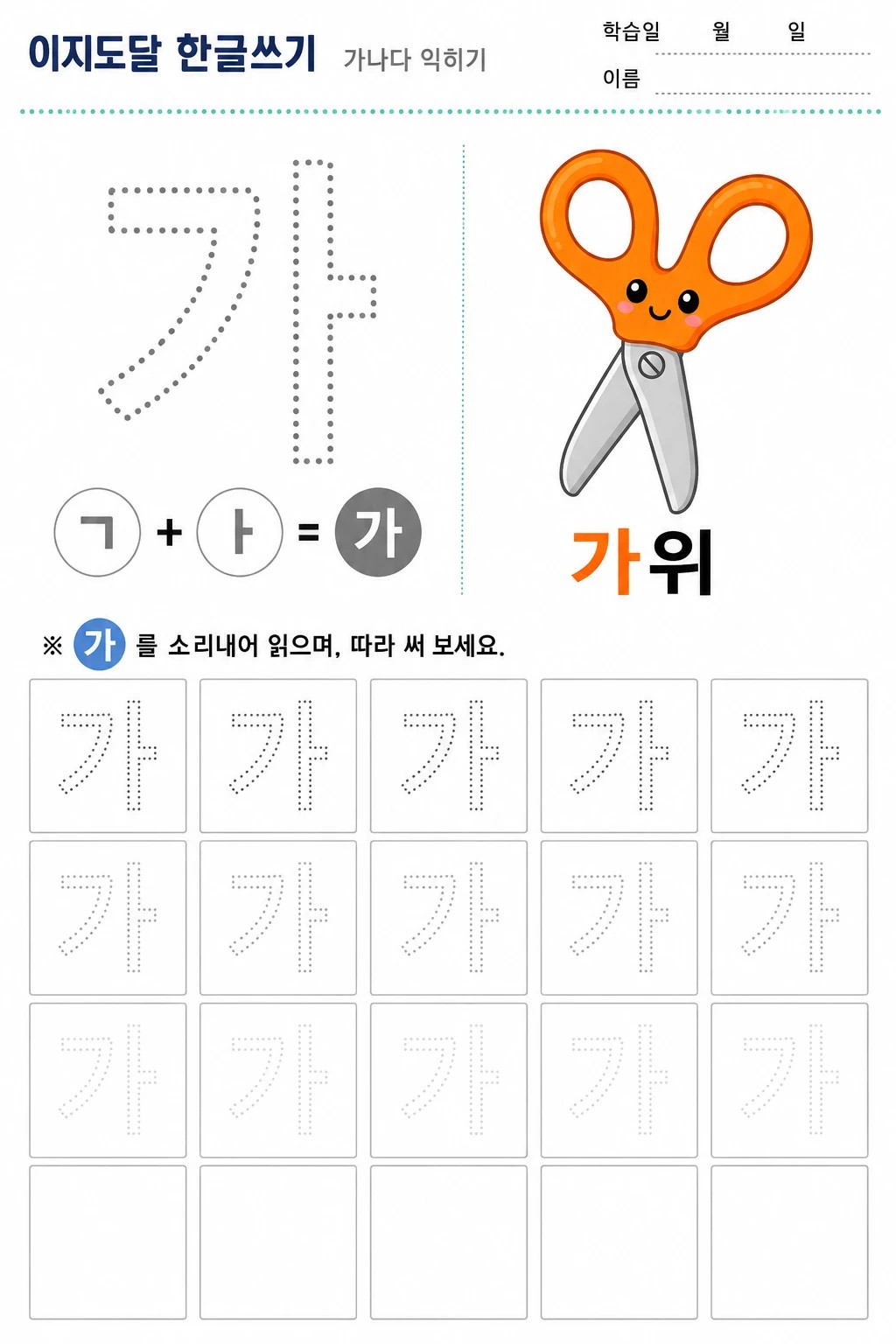
A Hangul syllable tracing worksheet for the 14 basic consonants combined with ㅏ (가/나/다/.../하). Pick one syllable and the page auto-composes: a large dotted character, jamo decomposition, an example word with cartoon illustration, and a 4-row tracing grid with fading guides.
Customize
Prompt
[Input]
- language: Korean
- output_size: 1024x1536 (A4 vertical portrait)
- target_char: {target_char}
- header_subtitle: {header_subtitle}
- student_name: {student_name}
- example_word: {example_word}
- example_translation: {example_translation}
- jamo_decomp: {jamo_decomp}
- illustration_hint: {illustration_hint}

[Purpose]
Printable Korean Hangul syllable tracing worksheet for one character, A4 vertical portrait. Designed for preschoolers (ages 5-7) to learn one Hangul syllable per page. No reference photo needed — pure text-to-image generation.

[Composition]
Three-band vertical layout on white A4 paper:

1) HEADER (top ~10% height):
   - Left: "이지도달 한글쓰기" in bold dark navy sans-serif (~28pt), with "{header_subtitle}" beside it in lighter gray (~18pt).
   - Right: "학습일   월   일" + "이름  {student_name}" — small dotted-underline fields for date and name.
   - Below the header: a thin mint dotted divider line.

2) LEARNING AREA (middle ~30% height) — split into left and right halves:
   LEFT HALF (60% width):
   - One large dotted-outline "{target_char}" character (~280px wide), in light gray dotted line style (점선체).
   - Below this large dotted character: a small jamo-decomposition diagram showing:
     gray circle (consonant) + black "+" + gray circle (vowel) + black "=" + solid darker circle "{target_char}"
     where the consonant and vowel come from "{jamo_decomp}".
   RIGHT HALF (40% width):
   - A friendly cartoon illustration of {illustration_hint}, child-friendly style.
   - Below illustration: the label "{example_word}" in bold sans-serif (~24pt). The FIRST character "{target_char}" rendered in red-orange (#ff7a00), and the remaining characters in black.

3) INSTRUCTION LINE (~5% height):
   - Left-aligned: "※" + a small blue circle containing "{target_char}" + " 를 소리내어 읽으며, 따라 써 보세요." (~15pt)

4) TRACING GRID (bottom ~55% height):
   - 5 columns × 4 rows = 20 square cells with thin light gray borders, evenly spaced.
   - Row-by-row tracing guide intensity (top to bottom):
     * Row 1 (5 cells): dark dotted "{target_char}" outline (#999999) — strongest guide
     * Row 2 (5 cells): medium dotted "{target_char}" outline (#bbbbbb)
     * Row 3 (5 cells): light dotted "{target_char}" outline (#dddddd)
     * Row 4 (5 cells): completely EMPTY — no dots, no guide, just empty square

[Core Structure]
- Total page: 1024x1536, white paper background.
- Header band ~150px tall, Learning area ~460px tall, Instruction line ~70px tall, Tracing grid ~840px tall.
- Tracing grid cells are equal-sized squares with comfortable padding.

[Style Rules]
- All Korean characters rendered precisely, no broken jamo.
- Large dotted character and tracing dotted characters use Korean tracing font style (점선체) — small evenly-spaced dots forming the character outline.
- Solid characters (brand name, example word label) use thick sans-serif Korean font (Pretendard Bold or Cafe24 Ohsquare Bold).
- Mint (#5fb4b4) for header divider line only.
- Red-orange (#ff7a00) ONLY for the FIRST character of "{example_word}".
- Cartoon illustration: friendly, simple, child-friendly, NOT photographic.
- Pure white background, clean print-ready look.

[Visual Style]
- Flat scanned worksheet look, top-down orthographic.
- Even neutral lighting, no shadows.
- High contrast for tracing dots so children see them clearly.

[CRITICAL — Korean text accuracy]
Render ALL Hangul correctly:
- Brand: "이지도달 한글쓰기"
- Subtitle: "{header_subtitle}"
- Date label: "학습일   월   일"
- Name label: "이름"
- Name value: "{student_name}" (may be empty)
- Large dotted character: "{target_char}"
- Jamo decomposition reading: "{jamo_decomp}" resolving to "{target_char}"
- Example word label: "{example_word}" (first char "{target_char}" red-orange, rest black)
- Instruction: "※ {target_char} 를 소리내어 읽으며, 따라 써 보세요."
- 15 dotted "{target_char}" tracing characters in rows 1, 2, 3 (5 each)
Double-check every Hangul syllable.

[CRITICAL — Tracing format]
- Dotted characters MUST show evenly-spaced individual dots forming the outline.
- Solid characters (brand, example word) are FILLED solid color.
- Row 4 MUST be completely empty squares with no marks inside.

[🚫 PROHIBITED]
- Broken or misrendered Hangul characters
- Solid-filled tracing characters (must be dotted)
- More than 15 dotted tracing characters
- Multiple illustrations (only ONE illustration of {illustration_hint})
- English text anywhere in the worksheet
- Stroke order numbers (no ①②③ inside the dotted character)
- Background patterns or decorations
- Filling row 4 with any dots or guidesPrompt is long, so it is copied to clipboard instead of auto-filling. Paste in the new ChatGPT tab with Ctrl+V.
About this concept
Hangul Syllable Tracing 가~하 is a ChatGPT prompt that generates a Hangul tracing worksheet for 14 consonants with jamo breakdowns, sample words, and tracing guides without attaching a photo. Copy the prompt for free and paste it into ChatGPT to create the result directly, which can be used for sharing on KakaoTalk, printing, or Instagram posts.
Related




FAQ
Do I need to attach a photo?▾
No. This card generates a Hangul tracing worksheet from scratch — just send the prompt to ChatGPT, no photo needed.
Can I make a different worksheet every day?▾
Yes — pick one of the 14 syllables (가/나/다/라/마/바/사/아/자/차/카/타/파/하) for a new worksheet each day. In a month you cycle through the whole basic Hangul alphabet twice.
What if the dotted Hangul gets garbled?▾
AI image models don't always render Korean dotted tracing perfectly. Send a follow-up like 'Redraw the large left character as 가 in Korean dotted tracing font, exact shape' and it will redraw correctly.
The jamo decomposition diagram (ㄱ + ㅏ = 가) is missing▾
AI image models sometimes skip the jamo diagram. Send a follow-up: 'Add a jamo decomposition diagram ㄱ + ㅏ = 가 below the large left character.'
Is the print resolution enough for daycare use?▾
It prints crisply up to postcard size. For larger prints like A4, ask your print shop for a quality boost option for the smoothest result.